Alright y’all, time for a little round up.
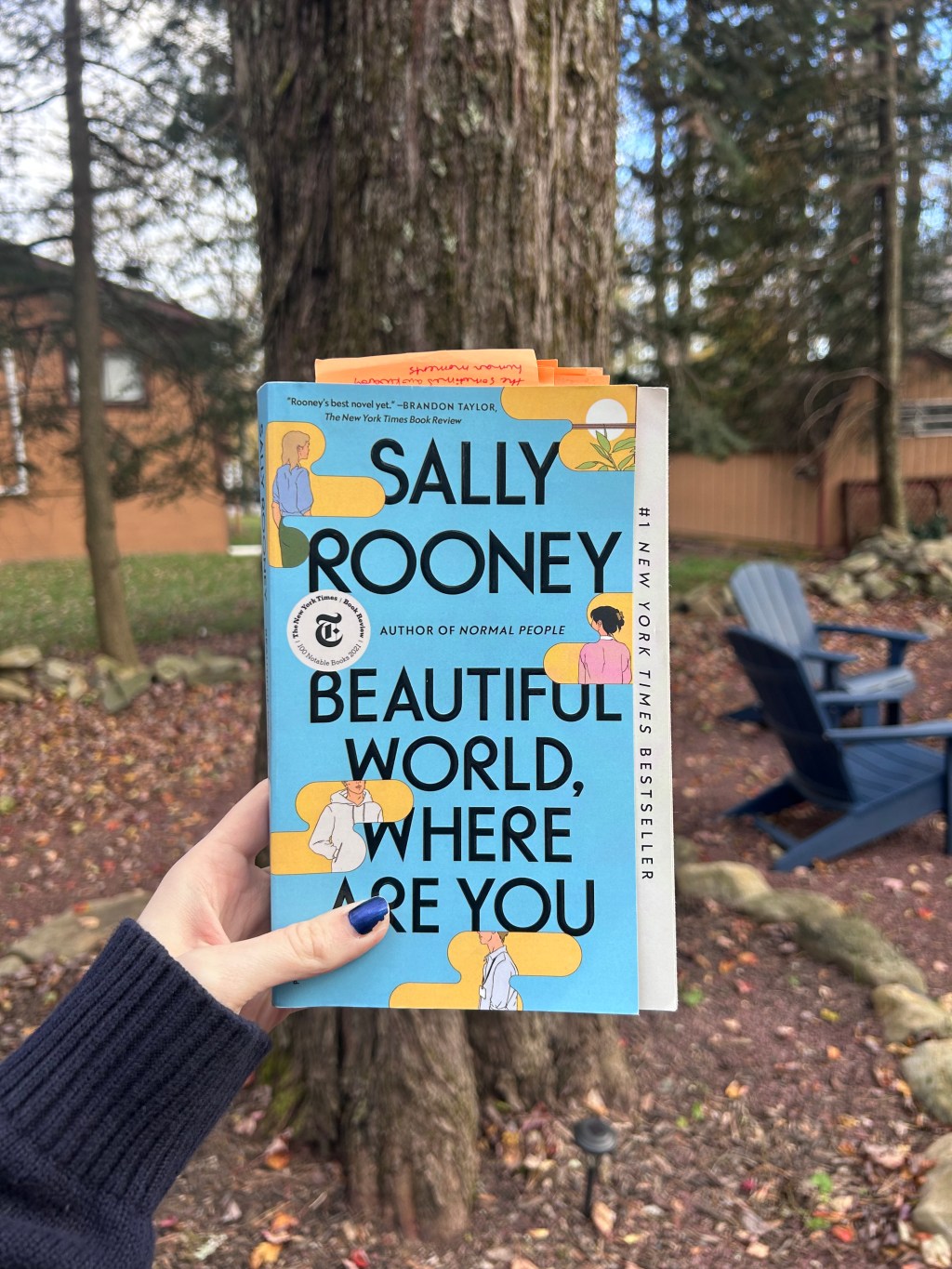
I finished “Beautiful World, Where Are You” by Sally Rooney last week, and I’ve been eager to chat about my experience with it!
To be completely honest, it took me a little while to really get into this book. I’ll make an educated guess and say probably more than 50 pages, and maybe a little less than 100 pages. For reference, my copy is a little over 350 pages.
Once I started getting into the book, the first thing I noticed was how descriptive the scenes were. Rooney took up space on her pages by describing the mundane, everyday things that another author may skip over to get to the next scene. But Rooney spent time with the clothes characters were wearing, how their bodies moved, and what the surrounding environment looked like. When authors do this, it makes me feel like something in a book could really happen. It helps me develop a better picture in my mind, and it allows me to understand the characters’ human complexities.
The story follows four characters: Alice, Eileen, Felix, and Simon. The chapters are broken up through email correspondence between Alice and Eileen, that spans from everyday catch-up, to breaking down philosophies, to dissecting the state of the world.
On page 146, Rooney writes, “So of course in the midst of everything, the state of the world being what it is, humanity on the cusp of extinction, here I am writing another email about sex and friendship. What else is there to live for?”
Alice is a bestselling novelist, and Felix is a warehouse worker. They meet on Tinder, and despite seeming romantically incompatible, they stay in each other’s lives for a while.
Eileen works at a literary magazine and Simon works in politics. They’ve grown up together and now both live in Dublin. These two have an interesting relationship that spans across the spectrum of best friends to scorned lovers, and everywhere in between.
Throughout the book, I felt like I wasn’t really rooting for any particular character. Everyone had their faults, and these were left out in the open for the reader. For example, Felix acts condescendingly towards Alice to combat his insecurity that stems from Alice’s success. It was often difficult to read, but it told me more about Alice as I read how she reacted to this behavior. I learned more about how her mind works, and this gives her character a lot more depth.
Later on, Eileen and Simon visit Alice and Felix in the Irish countryside. We learn little things about how each character thinks, from how they interact in the group, and what they say in one-on-one side conversations. Eileen and Simon are fresh off of a fight when they come to visit, so tensions are high. The relationship between these two did frustrate me a bit while reading because there’s a lot of back and forth with them. They live in a grey area, dating other people while still seeing each other romantically, knowing they have love for each other but not completely set on taking the jump and getting into an actual relationship. It can be a lot.
While it may seem like my time with these characters came with a steady stream of distaste, I did enjoy my reading experience. I treated my it as if I was an outsider looking in. I was an observer, taking note of the multi-faceted relationships between Alice, Eileen, Simon, and Felix. I could see the good and the bad, and had constant conflicted feelings, much like the characters in the book. This is what I really liked about the book. I liked that I was confused. I liked that I wasn’t given this fantastical story of best friends and lovers. And I liked that there was a good amount of conflict. It felt real, it felt human, and it left an impact.
Some memorable quotes to end off with:
“I had already become the person I had once longed to be, and now energetically despised” (245).
“They looked at one another for a long moment without moving, without speaking, and in the soil of that look many years were buried” (252).
“I’m going to try being nice to you for a while” (269).
“Inside, four bodies sleeping, waking, sleeping again. On their sides, or lying on their backs, with the quilt kicked down, through dreams they passed in silence” (270).
“And life is more changeable than I thought” (352).
Talk soon,
Julianne




 Julsbookdiaries
Leave a comment